The Hidden Costs of Running Your Business Without an ERP
Most business owners think not having an ERP system is saving them money.
Simon Cardona
CEO
Management
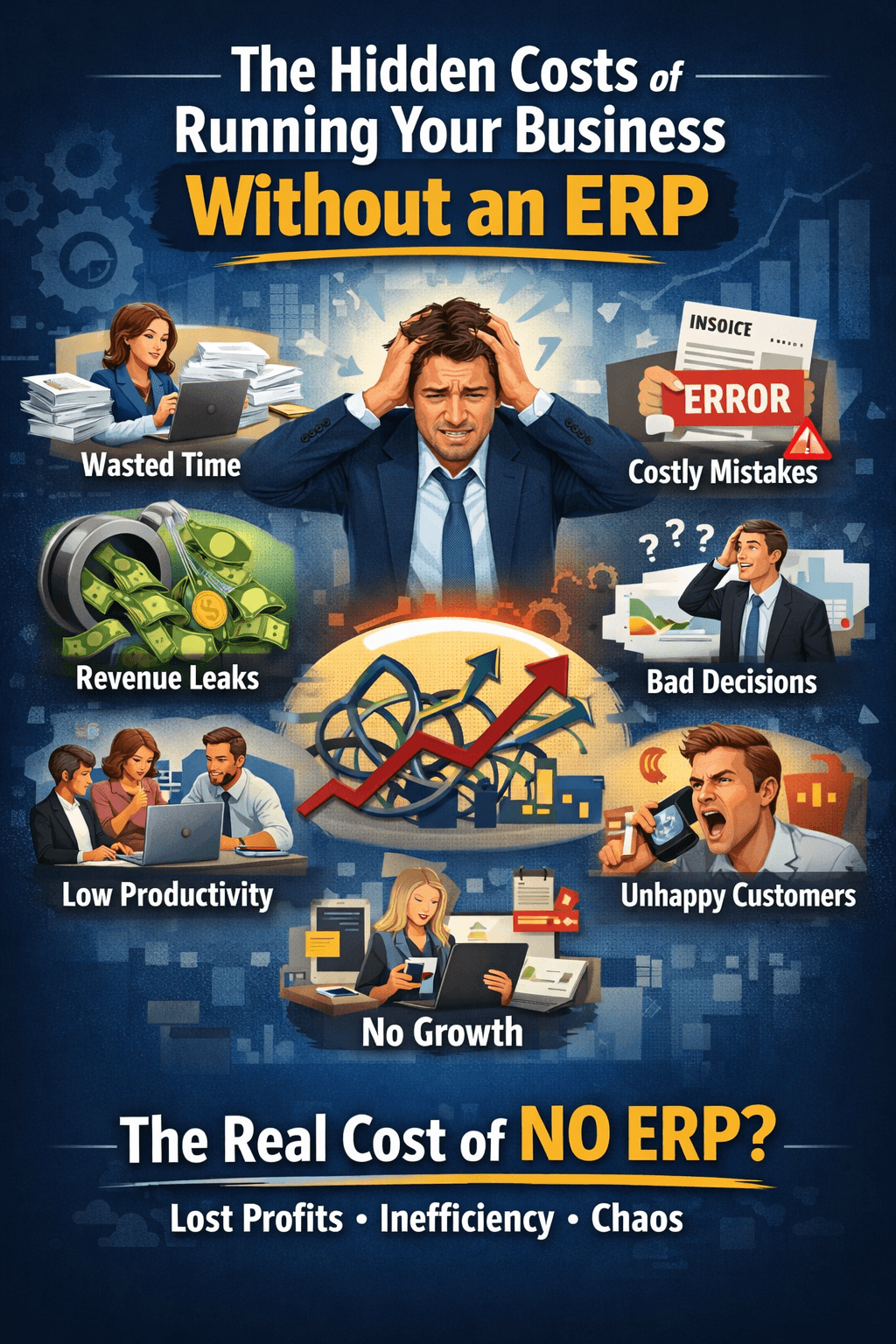
Most business owners think not having an ERP system is saving them money.
After all, why invest in software when you can manage things with spreadsheets, QuickBooks, emails, and a few apps?
But here’s the truth:
Not having an ERP is costing you far more than you think.
The problem is—these costs are hidden.
Let’s break them down.
1. Time Lost in Manual Work
Every time your team:
Re-enters data into multiple systems
Updates spreadsheets manually
Searches for information across emails or chats
You’re losing valuable time.
What feels like “just a few minutes” adds up to:
Hours per week
Days per month
Thousands of dollars per year
👉 Reality: You’re paying employees to manage inefficiencies instead of producing results.
2. Costly Human Errors
Manual systems create room for mistakes:
Wrong pricing
Incorrect invoices
Missing job costs
Duplicate entries
Even small errors can:
Damage your reputation
Delay payments
Reduce profit margins
👉 Reality: One mistake can cost more than an entire ERP subscription.
3. Revenue Leaks You Don’t See
This is where most businesses lose the most money—without realizing it.
Examples:
Jobs underpriced due to poor cost tracking
Unbilled work or forgotten change orders
Missed follow-ups with leads
Inefficient resource allocation
👉 Reality: You’re not just losing money—you don’t even know where.
4. Poor Decision-Making
Without centralized data:
Reports are outdated
Numbers don’t match
You rely on guesswork
You might ask:
“Are we actually profitable?”
“Which jobs are making money?”
“Where are we losing time?”
And not have clear answers.
👉 Reality: Decisions without data are just guesses.
5. Low Team Productivity
When your systems are disconnected:
Teams constantly switch between tools
Communication gets lost
Tasks fall through the cracks
This leads to:
Delays
Frustration
Burnout
👉 Reality: Your team is working hard—but not efficiently.
6. Bad Customer Experience
Customers feel your internal chaos:
Slow responses
Inaccurate quotes
Poor communication
Missed deadlines
In today’s market, that means one thing:
👉 They go somewhere else.
7. The Cost of Not Scaling
As your business grows:
Complexity increases
Processes break
Systems can’t keep up
Without an ERP:
Growth becomes stressful
Operations become chaotic
Opportunities are missed
👉 Reality: You hit a ceiling—not because of demand, but because of systems.
So… What’s the Real Cost?
Let’s summarize what “not having an ERP” is really costing you:
Lost time (labor cost)
Human errors (financial loss)
Missed revenue (invisible leaks)
Poor decisions (strategic loss)
Low productivity (team inefficiency)
Lost customers (reputation + revenue)
Limited growth (scalability issues)
👉 When you add it all up, the cost is massive.
Final Thought
Most businesses don’t fail because of lack of effort.
They fail because of lack of systems.
If your business feels:
Disorganized
Reactive instead of proactive
Stuck despite growing demand
Then it’s not a people problem.
It’s a systems problem.
🚀 Take Back Control
At CAG Software Development, we built PCS (Project Control System) to eliminate these hidden costs and give service businesses:
Full visibility
Automated workflows
Real-time data
Scalable operations
👉 Stop losing money in ways you can’t see.
👉 Start building a business that runs on systems.