Why You Don’t Actually Know Your Profit Margins
Most business owners believe they know their numbers.
Simon Cardona
CEO
Management
Most business owners believe they know their numbers.
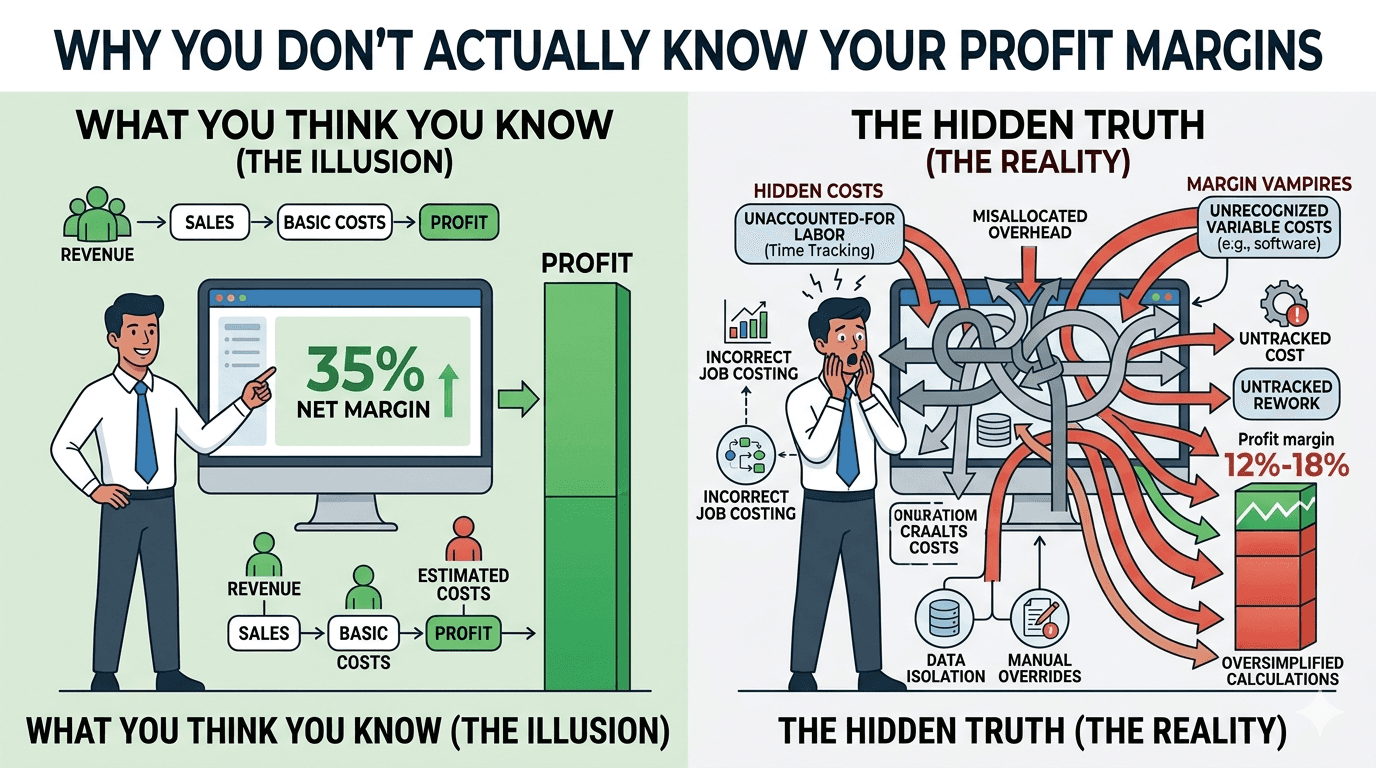
They check their bank account, review their invoices, maybe look at QuickBooks—and assume they understand their profit margins.
But here’s the uncomfortable truth:
👉 Most service businesses don’t actually know their real profit margins.
Not because they’re careless.
But because their systems don’t give them the full picture.
Let’s break down why.
1. You’re Only Looking at Surface-Level Numbers
Revenue ≠ Profit.
Just because a job brought in $10,000 doesn’t mean you made money.
What’s often missing:
Labor hours (actual vs estimated)
Material overruns
Equipment usage
Hidden operational costs
Without tracking all of this in one place, you’re only seeing part of the story.
👉 Reality: You’re measuring income—not profitability.
2. Your Costs Are Scattered Everywhere
In most service businesses, data lives in different places:
Estimates in one system
Expenses in another
Time tracking (or not tracked at all)
Notes in WhatsApp or emails
There’s no single source of truth.
So what happens?
👉 You can’t accurately connect:
Cost → Job → Profit
Result: Your margins are based on assumptions, not data.
3. You’re Not Tracking Jobs in Real Time
By the time you realize a job went over budget… it’s too late.
Without real-time tracking:
Labor hours exceed estimates
Materials go over budget
Scope changes aren’t recorded
And no one catches it during the job.
👉 Reality: Profit is lost during execution—not after.
4. Small Leaks Are Killing Your Margins
Profit doesn’t disappear in one big mistake.
It leaks slowly:
1–2 extra hours per job
Small unbilled changes
Inefficient crew scheduling
Wasted materials
Individually, they seem small.
But across dozens of jobs?
👉 They destroy your margins.
5. You Don’t Know Which Jobs Are Actually Profitable
Not all jobs are equal.
Some:
Look good on paper
Keep your team busy
But generate low or negative margins
Others:
Are highly efficient
Require fewer resources
Generate strong profits
Without proper tracking:
👉 You can’t tell the difference.
So you keep doing more of the wrong work.
6. Your Pricing Is Based on Guessing
If you don’t know your real costs…
You can’t price correctly.
That leads to:
Underpricing jobs
Losing money while staying busy
Competing on price instead of value
👉 Reality: You’re working harder, not smarter.
7. You’re Using Tools That Weren’t Built for Your Business
Spreadsheets, generic accounting tools, and disconnected apps weren’t designed to:
Track job-level profitability
Connect operations with finances
Give real-time insights
They show you:
👉 What happened
But not:
👉 What’s happening right now
👉 Or what’s about to go wrong
So… Do You Actually Know Your Profit Margins?
Ask yourself:
Do you know the exact profit of each job?
Can you track labor and material costs in real time?
Do your numbers update automatically as work happens?
Can you identify which services are most profitable?
If the answer is no (or even “kind of”)…
👉 Then you don’t truly know your margins.
The Fix: Systems, Not Guesswork
Profitability isn’t about working harder.
It’s about having:
Accurate data
Connected systems
Real-time visibility
With the right system, you can:
Track every cost
Monitor every job
Make decisions based on real numbers
🚀 Turn Data Into Profit
At CAG Software Development, we built PCS (Project Control System) to give service companies:
Real-time job cost tracking
Automated workflows
Full financial visibility
Clear profit insights per project
👉 Stop guessing your margins.
👉 Start controlling them.